 CloudKites
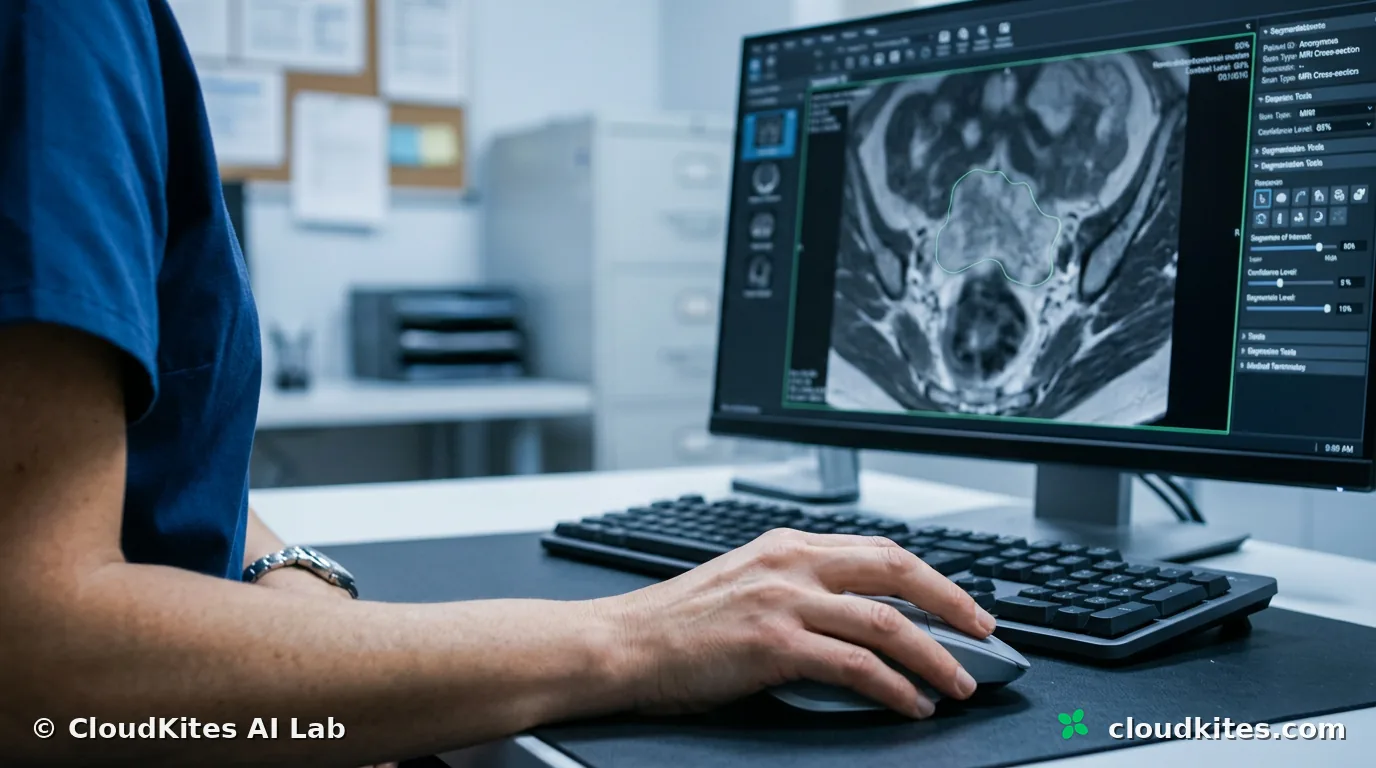
There is a quiet but consequential choice at the heart of every clinical AI product: is the software a decision-maker, or is it an assistant to one? It is tempting to treat this as a question of degree — a slider you can nudge toward more automation as confidence grows. We do not see it that way. For us it is a fixed design stance, set before the first feature is drawn, and it governs how findings are surfaced, how outputs are recorded, and how a clinician reviews, edits, or overrides them.
Assistive by design means the clinician decides and the tool supports that decision. That sentence is short, but living up to it is not. It has implications for the user interface, the report, the audit trail, and the accountability that follows a case long after it is closed.
Assistance is a stance, not a disclaimer
It is easy to put “for assistance only” in a footer and carry on building something that quietly behaves like an oracle. A pre-checked box, a finding presented as settled fact, a default that is tedious to undo — each of these nudges a clinician toward accepting the machine’s view without really examining it. The disclaimer says one thing; the design says another, and people respond to the design.
So we treat assistance as an engineering constraint rather than a legal posture. A suggestion has to look like a suggestion. The clinician’s judgement has to be the path of least resistance, not an exception that requires effort to assert. When the software is uncertain, that uncertainty should be visible rather than smoothed away into a single confident-looking output. The goal is not to make the AI seem more authoritative; it is to make the human’s review faster and better informed.
The human in the loop is a verifier and an approver
“Human in the loop” can mean very little if the human is reduced to clicking accept on whatever the model produces. We draw the role more sharply: the clinician is a verifier and an approver, and nothing leaves the system as final without that approval.
In practice this means an AI-assisted output is a draft until a qualified person signs it. In our radiology layer, TomoPod produces semi-automated reports, but the radiologist remains the verifier and approver — the report is theirs, shaped by what they confirm, correct, or discard. In pathology, PathoPod brings whole-slide images and computational assistance to the anatomical-pathology lab, and the web viewer is built for collaborative review at the tumour board, not for quietly replacing the pathologist’s sign-out. In endoscopy, EndoPod offers real-time assistance during the procedure, but the endoscopist is the one acting on what they see; the system informs the moment rather than overriding it.
The common thread is that the model’s contribution is always offered into a human workflow, never substituted for it. The clinician can accept a suggestion, change it, or set it aside entirely, and the system has to make all three of those actions equally first-class.
How this shapes the interface
A few principles follow directly from the stance, and they show up in the parts of the product people actually touch.
- Findings are surfaced, not asserted. The viewer presents what the model has flagged as something to look at, with the underlying image or data always one glance away. The clinician confirms against the source rather than against a summary.
- Defaults favour review. Nothing is pre-accepted. An AI-assisted suggestion enters the report only when the clinician puts it there, and editing or rejecting it is as simple as accepting it.
- Overrides are normal, not adversarial. Disagreeing with the model is an ordinary, frictionless action — not a buried setting or a warning-laden exception. A tool that punishes you for overriding it is not really assistive.
- Uncertainty stays legible. Where the system is unsure, the interface says so, rather than collapsing a hard case into a clean, misleadingly confident result.
None of this is decoration. Each choice is there to keep the clinician’s attention where it belongs — on the patient and the evidence — while reducing the mechanical work of getting from images to a finished, accountable report.
Reporting and the record
Assistance does not end when the clinician makes a call; it has to be reflected in what gets written down. An AI-assisted report should make clear that it was assisted, and it should record the human decisions that produced the final version. That is partly a matter of honesty and partly a matter of safety: anyone reading the record later — a colleague, an auditor, the clinician’s future self — should be able to see what the tool offered and what the person decided.
Because the report flows through standards the rest of medicine already speaks — DICOM and HL7 across the RIS, PACS, LIS and EIS — the assisted output lives inside the existing record rather than off to the side in a proprietary silo. The assistance is part of the clinical workflow, not a separate gadget bolted on next to it. And because edge tools and pods exchange information asynchronously between the point of care and the wider system, the timing of that exchange never forces a clinician to wait on a remote response before they can act.
Accountability has to land on a person
This is ultimately why the stance matters. Accountability for a clinical decision cannot be delegated to software. A model does not carry a duty of care; a clinician does. If a system is designed so that the human is merely rubber-stamping machine output, then accountability has quietly gone missing even though, on paper, someone signed.
Designing for assistance keeps accountability where the law and good practice already put it. The clinician who approves a report is genuinely the author of it, because the system gave them the means to verify, the freedom to override, and a record that reflects their decisions. The audit trail is not there to shift blame onto the tool; it is there to show, faithfully, that a qualified person made the call with good support.
Better assistance, not more autonomy
Our systems are AI-assisted-ready by design: models plug in and extend over time, and the assistance available in endoscopy, pathology and radiology will keep getting better as that happens. But “better” here has a specific meaning. It does not mean steadily handing more of the decision to the machine. It means making the clinician faster, better informed, and more able to focus on the cases and details that matter most.
That is the promise of assistive by design. The tool earns its place by improving the work, not by taking it over. The clinician decides; the system supports — and we build every part of the product, from the first pixel of the viewer to the last line of the audit trail, to keep it that way.