 CloudKites
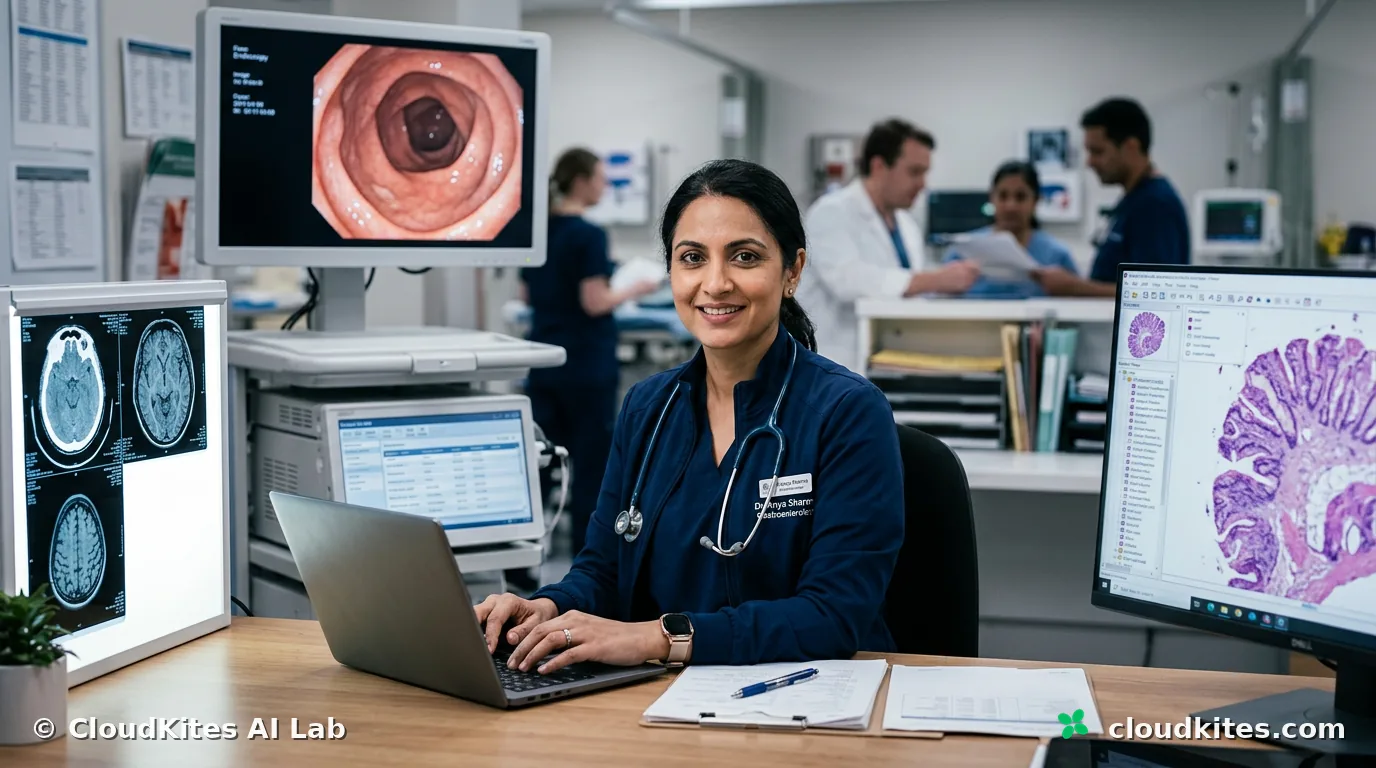
“Human in the loop” has become one of those phrases that can mean almost anything, which is another way of saying it risks meaning nothing. A tool can technically keep a person in the loop while making it impractical for them to do anything but click approve. The loop is present on the diagram and absent in practice. We think the phrase only earns its keep if the human is genuinely able to understand, question, and override what the tool proposes — not just nominally present, but actually in control.
That is a high bar, and it is meant to be. The whole reason a clinician sits in the loop is that they carry responsibility no software can carry for them. A patient is not treated by a model; they are treated by a person who has weighed the evidence and made a judgement they are prepared to stand behind. If our tools make that judgement easier to reach and easier to defend, they are doing their job. If they quietly erode it — by rushing it, obscuring it, or dressing a guess up as a fact — they are doing harm, however impressive the demo looks.
The difference between present and in control
There is a meaningful gap between being shown an output and being able to interrogate it. A finding that arrives with no way to see why it appeared invites one of two responses, and both are unsafe. The first is blind acceptance: the output looks confident, the queue is long, and clicking approve is the path of least resistance. The second is blanket distrust: once a clinician has been surprised by an unexplained result, the rational move is to stop relying on the tool entirely, at which point it is just an expensive source of friction.
Neither failure mode is the clinician’s fault. They are properties of the tool. An output that cannot be examined cannot be meaningfully reviewed, so the design has to make examination the easy path rather than the heroic one. That means our outputs are deterministic and logged: the same input gives the same result, and every step can be retraced afterward. Being able to look back is what turns “staying in the loop” from a formality into a real choice. A clinician who can see how a conclusion was reached can agree with it, refine it, or set it aside — and crucially, can explain to a colleague, a patient, or an auditor why they did.
Support is not a verdict
How a result is framed matters as much as how it is computed. A suggestion dressed up as a verdict quietly shifts responsibility away from the person who should hold it. Language does this; so does layout, defaults, and the sheer authority of a clean interface. If a screen presents a conclusion as settled, the honest work of deciding has already been nudged off the clinician’s desk before they have touched it.
So we are careful to present support as support — never as a decision, never as something that has already happened. The clinician reads, weighs, and decides; the tool makes that faster and better-informed, not automatic. This is not modesty for its own sake. It is the only framing consistent with where accountability actually lives. The verifier-and-approver pattern that runs through our products is the practical expression of this: the system can prepare, draft, highlight, and pre-fill, but the act that counts — the sign-off — belongs to a named person who remains free to change it.
The same principle, three imaging domains
This is easiest to see in our edge-and-pod imaging tools, where the temptation to let automation run ahead is strongest and the consequences of doing so are most direct.
Endoscopy
In endoscopy the assistance is real-time, which makes the discipline even more important. EndoPod’s role is to draw attention — to surface something worth a second look during the procedure and to organise the imaging record afterward. What it does not do is decide on the clinician’s behalf. The endoscopist is the one watching the screen, the one with the scope in hand, and the one whose judgement determines what happens next. The tool earns its place by sharpening attention, not by substituting for it.
Pathology
Whole-slide imaging brings a different rhythm. PathoPod makes slides reviewable, shareable, and teachable — supporting the web viewer used in education and at the tumour board as readily as routine sign-out. Here “in the loop” means the pathologist’s reading is the reading. The platform’s job is to make that reading easier to perform, to revisit, and to discuss with colleagues, while keeping the chain from specimen to conclusion legible. Collaboration is a feature; quiet automation of the diagnosis is not.
Radiology
Radiology shows the verifier-and-approver model in its clearest form. TomoPod can prepare a semi-automated report, but the radiologist is the verifier and the approver, full stop. A draft is a starting point that saves keystrokes and surfaces structure — never a conclusion that arrives pre-blessed. The radiologist reads the study, corrects what needs correcting, and signs only what they are prepared to stand behind. The time the tool saves is time returned to judgement, not time taken from it.
Myro, and a voice that knows its place
The same principle has to survive contact with an agentic assistant, where it is arguably hardest to hold. Myro works across the workflow through voice and text, and the more capable and conversational an assistant becomes, the more naturally it is trusted — sometimes more than it has earned. A fluent answer feels authoritative whether or not it deserves to.
So Myro is built to assist and to defer. It can gather context, draft, summarise, and act through the integrations a clinician already relies on, but it operates under supervision and routes consequential steps back to a person for confirmation. The aim is an assistant that reduces the busywork around a decision without ever quietly making the decision itself. Convenience is welcome; convenience that dissolves accountability is not, and we would rather Myro ask than assume.
The bar we hold ourselves to
The honest version of “in the loop” is more demanding than the marketing version, and that is the point. It asks more of the tool: deterministic outputs that can be retraced, framing that refuses to overstate, and workflows that keep the decisive act in human hands across endoscopy, pathology, radiology, and the assistant that ties them together.
A clinician is accountable for the decisions they make. A tool that wants to help them should make that accountability easier to carry, not harder — and it should never, even by accident, take the decision out of their hands. That is not a constraint we accept reluctantly. It is the whole reason the work is worth doing. Better care comes from better-supported judgement, and judgement is precisely the thing that has to stay human.