 CloudKites
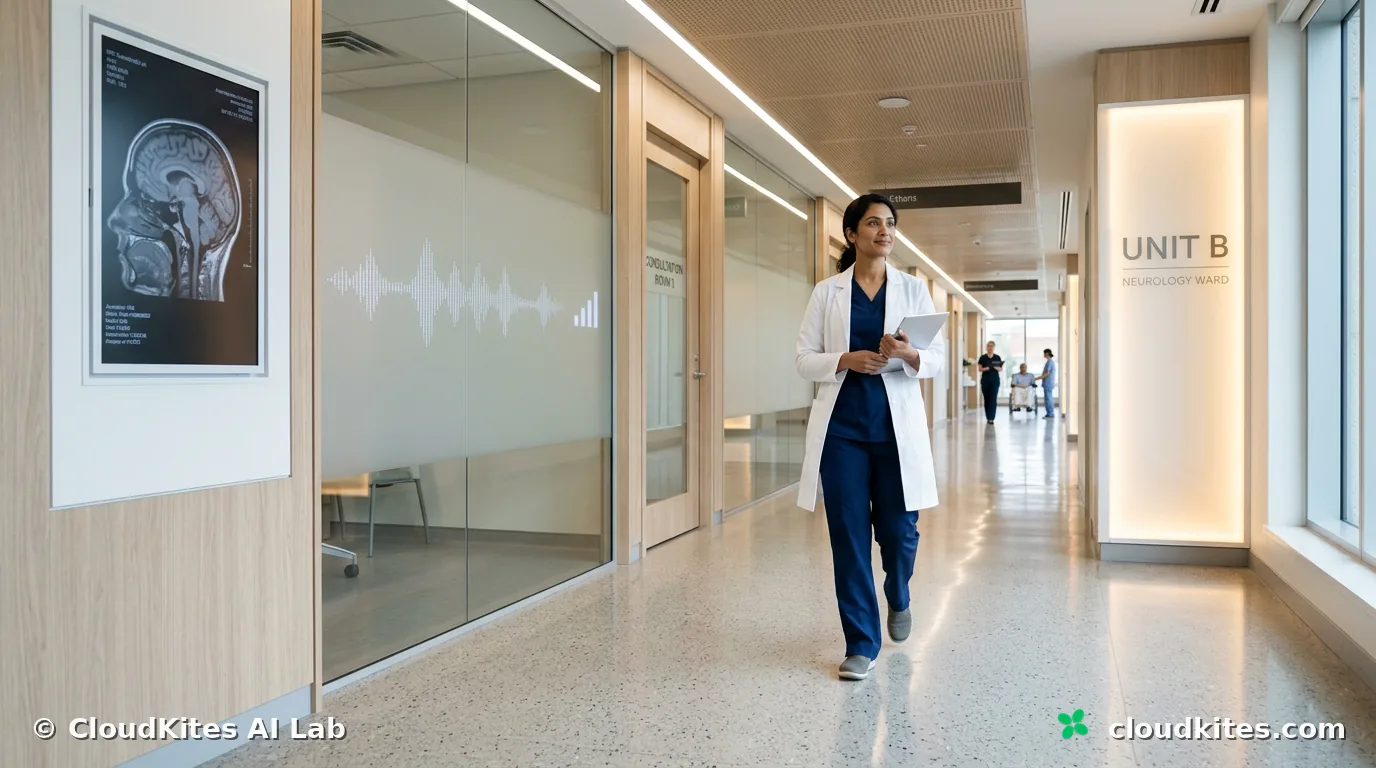
It is tempting, when talking about where AI in medicine is going, to leap straight to the picture that captures the imagination: a robot at the bedside, moving and speaking and helping. We do think about that picture. But the honest account of how anyone gets there is far less cinematic and far more important. It is a sequence of earned steps, each one resting on the trust established by the one before. Skip a step and you do not arrive sooner; you arrive at something unsafe, or you do not arrive at all.
So this is a deliberately grounded look at the trajectory we are building toward. It runs from AI-native imaging, through an agentic clinical assistant, toward an embodied clinical presence. Each stage is useful on its own. None of them depends on a promise about the next one. And every one of them keeps the clinician in control, because that is the property that has to hold all the way along.
Why start with imaging
We begin with AI-native imaging because it is where assistance can prove itself under the clearest conditions. Imaging is structured, it is bounded, and its outputs are reviewable. A finding can be surfaced, examined, and signed off by a person who remains accountable for it. The verifier-and-approver pattern that sits at the heart of our radiology work — a prepared, semi-automated report that a radiologist verifies and approves — is not just a workflow detail. It is the template for everything that follows.
Imaging also forces the discipline early. Working in endoscopy, pathology, and radiology with the standards those fields already depend on means assistance has to slot into real clinical practice rather than around it, while keeping a person firmly in the decision. If a tool cannot be trusted here, where the task is well defined and the output is inspectable, it has no business being trusted anywhere harder. Getting imaging right is how a system earns the right to do more.
From a tool you reach for to one that works alongside you
A tool waits to be picked up. An assistant participates. The step from imaging to an agentic clinical assistant is the step from the first to the second — and it is a real change in kind, not just in capability.
Myro is that assistant. It works across the workflow rather than inside a single view, through duplex voice and text, and it connects to the systems clinicians already use. The shift is that Myro can carry context between tasks, take helpful actions, and reduce the busywork that surrounds a clinical decision — not just answer when asked. That is genuinely more useful. It is also where the temptation to over-delegate gets stronger, because a fluent, capable assistant is trusted more readily than it has yet earned.
This is why agency, in our framing, always means agency under supervision. Myro extends assistance across the workflow, but the consequential moments still route back to a person for confirmation. It is built to do the legwork around a judgement without ever quietly making the judgement itself. The more it can do, the more carefully it has to be held to that line — and the imaging work is what taught us how to hold it.
Embodiment, stated plainly and without hype
Here is the part it would be easy to oversell, so we will state it plainly. The direction we are building toward includes embodiment: Myro as the brain of a future healthcare humanoid robot, an assistant that is not only on the screen but present in the room. We think that is a serious and worthwhile destination. We also think most of the talk about it is years ahead of the substance, and we would rather be clear about which is which.
Embodiment is the hardest step precisely because the physical world is unforgiving and the stakes are human. A presence at the bedside has to be dependable in ways a screen never has to be, and the burden of proof rises accordingly. So we treat it as a direction, not a date. What makes it credible is not a flashy prototype but the same brain, carrying the same context and the same discipline, into a physical form only once the layers beneath it have earned the weight. The robot, if and when it comes, is the last expression of a trustworthy assistant — not a shortcut past building one.
The thread that runs through all of it
What connects imaging, agency, and embodiment is not the technology. It is the stance. At every stage the clinician is the one in control: reviewing, overriding, and signing off on what matters. Assistance proves its value and earns trust; agency extends that across the workflow under supervision; embodiment, eventually, brings it to the bedside. The shape changes. The responsibility does not move.
This is also why the order matters and cannot be rearranged. Each step is grounded in what came before. You cannot responsibly put an agent across the workflow until assistance has proven itself, and you cannot responsibly put a body in the room until the agent has. Trust is accumulated, not announced. A system that has not been trustworthy on a slide or a study has not earned the right to be trusted on its feet.
A direction, built one earned step at a time
We find this framing clarifying rather than limiting. It tells us what to build now — better, more inspectable assistance in imaging — and it tells us what that work is in service of: an assistant capable of more, and ultimately a presence that can help where care actually happens. It also keeps us honest about pace. Each layer has to stand on its own and has to keep the clinician in control, or the next layer is not permitted to be built.
So this is a direction we build toward, step by grounded step. Not a leap to the robot, but a path to it — one whose every stage is useful today and whose every stage keeps the same promise. The destination is ambitious. The way we intend to reach it is patient, and that patience is the point.